
Drawing Spaces is a project space located at Fábrica Braço de Prata, in Lisbon, that seeks to promote investigative practices related to the subject of drawing. This project supports collaborations between artists and researchers from Portugal and artists and researchers from abroad. Drawing Spaces involves several artistic residencies and exhibitions; a series of lectures and debates; and various activities for specialized and non-specialized public related to the subject of drawing.
IT IS FORBIDDEN TO DRAW ON PAPER!
Pedro António Janeiro
13 April – 7 May 2011
Open Residency with public participation: 13 – 16 April 2011
IMAGES OF SESSIONS - ASPHALT, LIGHT, FIRE, FOUND OBJECTS
Open Residency: 27 - 30 April 2011
Exhibition Period: 4 - 7 May 2011
DRAWING SPACES - END OF A CYCLE
Opening / Project Presentation: 30 April, 21h
With the participation of:
Ana Leonor Madeira Rodrigues (FA-UTL) and Maria João Gamito (FBAUL)
Drawing Spaces – Espaços do Desenho, Fábrica Braço de Prata, Lisbon
Pedro António Janeiro
13 April – 7 May 2011
Open Residency with public participation: 13 – 16 April 2011
IMAGES OF SESSIONS - ASPHALT, LIGHT, FIRE, FOUND OBJECTS
Open Residency: 27 - 30 April 2011
Exhibition Period: 4 - 7 May 2011
DRAWING SPACES - END OF A CYCLE
Opening / Project Presentation: 30 April, 21h
With the participation of:
Ana Leonor Madeira Rodrigues (FA-UTL) and Maria João Gamito (FBAUL)
Drawing Spaces – Espaços do Desenho, Fábrica Braço de Prata, Lisbon
 |
 |
“A drawing is an object. To
draw is to enlarge the world.
I recall a child drawing on the floor with brush and water in a micro-cement courtyard. With water he would start saying, through lines and blotches, birds, houses, landscapes; he would draw what he saw; he would made up private mythologies; and pointing to the drawing he would said: “That’s me”. When the drawing was big, he would climb up a loquat overlooking the patio to see the drawing from up. One day, dazzled by what he saw while naming “me” to what he saw, he fell and broke his arm. The next day, the tree was not there anymore: it had been cut down right by the root. This image always impressed me.
I remember Piotr: Piotr was a Polish animated cartoon, intelligent, but very joyful. Piotr, with his yellow dog, each time faced by a peril, had an elf appearing to him who would lend him “the magic pencil”. This pencil with which Piotr drew on the ground had the power to materialize everything that Piotr drew and wish for: if a pair of white wings, Icarus; if a sailboat, a sailor; if a beach, a castaway.
I recall drawings made with the fingertips over the dust of car hoods; on the steamed windshields.
I recall drawings made with a piece of chalk on the black asphalt; the hand of a man imprinted or blown in ocher on the Lascaux walls.
A drawing al vif (“after nature”), amongst other things, is a kind of fragment that I cut off and steal from reality.
To draw is an accepted theft: because that which drawing steals is returned twice as much, or even more, by the drawing itself to the stolen reality. The product of my plunder is yet another object in the world: my drawing is my theft and my surrender. I state that I take, but I know that I give.
If I draw over a paper, I steal and take the stolen reality under my arm.
Interesting would be if that drawing that I make of that which I say that I see would be abandoned at the crime scene; if that drawing, which is another object in the world, would feed that reality that accepts to be stolen by the eyes (so that others, when seeing it, would also see it through one of its drawings; or, if drawn by them, they would draw it by drawing also my drawing) – this assuming the chosen media as fixed, like a wall, the asphalt, the glass of a window, etc; or yet, as an alternative, interesting would be if the chosen media was movable, like a car hood or a leaf of a tree, where the constructed drawing could travel away from here, making known the stolen-here. But why not on paper?
Because paper forces me to frame that which I see according to preset criteria pre-established by its dimension and standardize format. If I do not draw on paper, I have the whole world to construct my drawing on, without limits. The dimension, the scale to which I draw, I pick them myself.
Even before drawing becomes a drawing, paper already predicts it. The square and the rectangle want to be exposed.
My drawing is the narrow bridge over the precipice that separates me from things. Only this makes it worthwhile to draw, because drawing is to stretch the body and touch things, themselves as lived by me, in me.
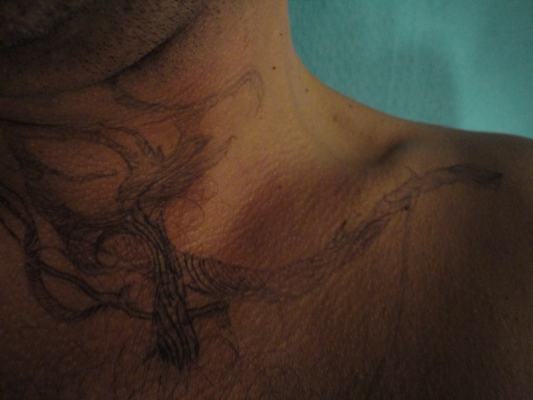
Perhaps this is why nowadays I have picked the palms of my hands and my own skin as supports for my drawings. Without paper or other surface, I gain more: I gain that sort of seduction that that who draws gets to know when feeling the confrontation of the tip of the pencil or pen with the intervened surface. Thus, I draw twice, for I feel the drawing happening in the hand that draws, and in the hand that consents the drawing. My body is my beginning and my end, my drawing is my resurrection.
Draw me a bird on sepia with a single line
In the shell that the palms of my hands are,
That flies higher than Painting,
That is not afraid to sink,
That makes a helm out of illusion,
That takes me for a prince
As certain as
All this blood of mine
Opal made of stone.
A branch that I find
At a beach of wonders
In all similar to a bull at a pagan place:
In blaknesses,
Whitenesses that make shiver
And ashes of human flesh without smell,
With nothing, between lilacs.
I taste the blood in my mouth,
For all the longing,
From seeing children desperate as I’ve been,
At a corner
Imagining the world
With the most supremely certainty that they have not even existed,
Waiting
For the knife to wound them,
But without pain,
At the center of the center
Of that which make their eyes see
While mourning flowers
Under a ceiling of clouds that roll dense
Cries of angels
Which have been burnt, through the power of fire
The eyes
Because I feed myself from the depth [darkness] that the world offers me.”
Pedro António Janeiro
The purpose of this project is to invite the participants to draw in supports other than paper; using non conventional materials. People are invited to draw, for example, on the asphalt, on the wall, on tree leaves, on the dust of cars (with ephemeral and non mutilating materials), on the ground, etc. On a second phase of the project, the artist will use his body as an interface for drawing.
Pedro António Janeiro, Lisbon, 1974.
Graduated from the Faculty of Architecture at the Technical University of Lisbon (F.A./U.T.L.), 1998; Master in Contemporary Architectonic Culture and Construction of the Modern City, F.A./U.T.L., 2003; Doctor in Architecture, speciallized in Theory of Architecture, F.A./U.T.L., 2008; teaches Drawing at the Faculty of Architecture from the Technical University of Lisbon since 1997; wrote various scientific papers and published the following books: Perspectivas (e Outras-Imagens) da Arquitectura I e II; Azul em Coma [Perspective (and Other-Images) of Architecture I and II]; Origens e Destino da Imagem, para uma fenomenologia da Arquitectura Imaginada [Origins and Destin of the Image, towards a phenomenology of the Imagined Architecture]; Desenhos a Éter [Ether Drawings]; A Imagem Por-Escrita (prelo) [The image In-Written].
I recall a child drawing on the floor with brush and water in a micro-cement courtyard. With water he would start saying, through lines and blotches, birds, houses, landscapes; he would draw what he saw; he would made up private mythologies; and pointing to the drawing he would said: “That’s me”. When the drawing was big, he would climb up a loquat overlooking the patio to see the drawing from up. One day, dazzled by what he saw while naming “me” to what he saw, he fell and broke his arm. The next day, the tree was not there anymore: it had been cut down right by the root. This image always impressed me.
I remember Piotr: Piotr was a Polish animated cartoon, intelligent, but very joyful. Piotr, with his yellow dog, each time faced by a peril, had an elf appearing to him who would lend him “the magic pencil”. This pencil with which Piotr drew on the ground had the power to materialize everything that Piotr drew and wish for: if a pair of white wings, Icarus; if a sailboat, a sailor; if a beach, a castaway.
I recall drawings made with the fingertips over the dust of car hoods; on the steamed windshields.
I recall drawings made with a piece of chalk on the black asphalt; the hand of a man imprinted or blown in ocher on the Lascaux walls.
A drawing al vif (“after nature”), amongst other things, is a kind of fragment that I cut off and steal from reality.
To draw is an accepted theft: because that which drawing steals is returned twice as much, or even more, by the drawing itself to the stolen reality. The product of my plunder is yet another object in the world: my drawing is my theft and my surrender. I state that I take, but I know that I give.
If I draw over a paper, I steal and take the stolen reality under my arm.
Interesting would be if that drawing that I make of that which I say that I see would be abandoned at the crime scene; if that drawing, which is another object in the world, would feed that reality that accepts to be stolen by the eyes (so that others, when seeing it, would also see it through one of its drawings; or, if drawn by them, they would draw it by drawing also my drawing) – this assuming the chosen media as fixed, like a wall, the asphalt, the glass of a window, etc; or yet, as an alternative, interesting would be if the chosen media was movable, like a car hood or a leaf of a tree, where the constructed drawing could travel away from here, making known the stolen-here. But why not on paper?
Because paper forces me to frame that which I see according to preset criteria pre-established by its dimension and standardize format. If I do not draw on paper, I have the whole world to construct my drawing on, without limits. The dimension, the scale to which I draw, I pick them myself.
Even before drawing becomes a drawing, paper already predicts it. The square and the rectangle want to be exposed.
My drawing is the narrow bridge over the precipice that separates me from things. Only this makes it worthwhile to draw, because drawing is to stretch the body and touch things, themselves as lived by me, in me.
Perhaps this is why nowadays I have picked the palms of my hands and my own skin as supports for my drawings. Without paper or other surface, I gain more: I gain that sort of seduction that that who draws gets to know when feeling the confrontation of the tip of the pencil or pen with the intervened surface. Thus, I draw twice, for I feel the drawing happening in the hand that draws, and in the hand that consents the drawing. My body is my beginning and my end, my drawing is my resurrection.
Draw me a bird on sepia with a single line
In the shell that the palms of my hands are,
That flies higher than Painting,
That is not afraid to sink,
That makes a helm out of illusion,
That takes me for a prince
As certain as
All this blood of mine
Opal made of stone.
A branch that I find
At a beach of wonders
In all similar to a bull at a pagan place:
In blaknesses,
Whitenesses that make shiver
And ashes of human flesh without smell,
With nothing, between lilacs.
I taste the blood in my mouth,
For all the longing,
From seeing children desperate as I’ve been,
At a corner
Imagining the world
With the most supremely certainty that they have not even existed,
Waiting
For the knife to wound them,
But without pain,
At the center of the center
Of that which make their eyes see
While mourning flowers
Under a ceiling of clouds that roll dense
Cries of angels
Which have been burnt, through the power of fire
The eyes
Because I feed myself from the depth [darkness] that the world offers me.”
Pedro António Janeiro
The purpose of this project is to invite the participants to draw in supports other than paper; using non conventional materials. People are invited to draw, for example, on the asphalt, on the wall, on tree leaves, on the dust of cars (with ephemeral and non mutilating materials), on the ground, etc. On a second phase of the project, the artist will use his body as an interface for drawing.
Pedro António Janeiro, Lisbon, 1974.
Graduated from the Faculty of Architecture at the Technical University of Lisbon (F.A./U.T.L.), 1998; Master in Contemporary Architectonic Culture and Construction of the Modern City, F.A./U.T.L., 2003; Doctor in Architecture, speciallized in Theory of Architecture, F.A./U.T.L., 2008; teaches Drawing at the Faculty of Architecture from the Technical University of Lisbon since 1997; wrote various scientific papers and published the following books: Perspectivas (e Outras-Imagens) da Arquitectura I e II; Azul em Coma [Perspective (and Other-Images) of Architecture I and II]; Origens e Destino da Imagem, para uma fenomenologia da Arquitectura Imaginada [Origins and Destin of the Image, towards a phenomenology of the Imagined Architecture]; Desenhos a Éter [Ether Drawings]; A Imagem Por-Escrita (prelo) [The image In-Written].
Drawing Spaces, Fábrica Braço de Prata
Rua da Fábrica do Material de Guerra, nº1, 1950 – 128, Lisbon
Near the riverside, next to ‘25 de Abril’ Plaza (roundabout), just before the ‘Expo’ area entrance
Bus: 28; Train Station: Braço de Prata (Connecting stations: Entrecampos, Roma, Sta. Apolónia).
Public Schedule: Wednesday – Saturday, from 19h to 23h
Website: www.drawingspaces.com Email: [email protected]
Facebook: facebook.com/drawingspaces.espacosdodesenho
|
|



Sponsors, Partners
|
|



 |
 |
|
© 2008-2011 Espaços do Desenho – Drawing Spaces • Todos os direitos reservados • All rights reserved
